Showing posts with label abortion. Show all posts

Friday, May 16, 2014

Hobby Lobby's Religion: Boko Haram


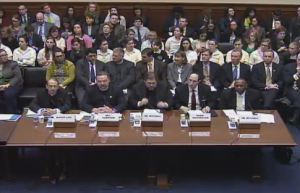
House of Reps. all-male hearing on contraception, 2012


Hobby Lobby today announced that although it is a corporation, it does indeed have a religion: Boko Haram.  When its Christian owners argued before the Supreme Court to assert their right to deny insurance coverage for 4 types of birth control on the basis of the corporation's religious beliefs, Justice Sotomayor questioned "How does a corporation exercise religion?"  The Corporation itself has so far been silent on its actual religious affiliation.


"With so many of our successful practices under attack around the globe this month, we felt it was time to speak publicly in defense of our faith.  On May 6, a Boko Haram leader claimed responsibility for abducting hundreds of Nigerian school girls, planning to sell them. In the U.S., with legislation in Missouri and Louisiana aiming to strip abortion providers of their right to practice, and  proposals advancing in Congress to ban abortions after 20 weeks, when low-income women and women with medical abnormalities are most likely to need them, our staunch doctrine of assuring the long-term, structural subservience of women has been making enormous strides.


"The firing of Jill Abramson for her 'brusque' management style as NY Times editor, to be replaced by the man who had responded entirely appropriately by punching a hole in the wall at the Times, was simply more than we could have hoped for.


"This cascade of previously unimaginable successes has of course inflamed uncontrollably whiny, emotional, and humorless feminist apparatchiks around the globe, from groups like a Billion Rising, and the Trust Women/Silver Ribbon Campaign.  These modern women and their supporters would convince the US Supreme Court that it's time to set the record straight and dismiss Hobby Lobby's arguments, simply because they reflect the last gasp of the backwards, fringe mentality we represent. And frankly, the recent denunciation of Boko Haram by Al Quaeda contributed to prompting our declaration. By coming out publicly to claim our corporation's religious affiliation with Boko Haram, we intend to put all such diversions to rest."


(The corporation went  on to explain how this unique circumstance entitled it to claim its independent right to assert that Plan B should not be covered by Hobby Lobby because it is an abortifacient, which is otherwise labeled by mainstream scientific evidence as "absolutely without any foundation whatsoever.")

Friday, June 17, 2011

Utter Madness

Will this be the month that tips us into action?

We can't get jobs, live in our homes, educate our kids.  Get out of the way of the tornadoes. Or, apparently, influence substantially the policy decisions imposed by an increasingly vicious and mean-spirited minority.

In California advocacy has been reduced to documenting the rubble.  Medicaid is cutting doctors' visits to 7 a year, for the seriously chronically ill who can still manage to qualify.  To his credit, I think, the Governor just vetoed a budget that has been a disaster for decades because no one can wrench control of the process from the 1/3 of the legislature whose most animating vision is to drown the government in a bathtub. We cannot add $70 a year to our car registration fees as a downpayment on staunching the demise. You might have missed this story because there was a sex scandal this week, and some baseball games. (I like baseball; not the point.)

Other states are dealing with the crisis by fomenting mobs who probably do not quite get the biological links among contraception, pregnancy and abortion, but are convinced they're against all of it, whatever it is.

Congress will not tax a cent of a billionaire's gains from gambling on the stock market, but voted to cut the Women and Infant Children program that gets some minimum level of nutrition to indigent kids.  The Administration of course is taking a strong lead in rallying the nation to hold off on arbitrary cuts to the Social Security benefits of the 50% of seniors who subsist on meager incomes, and to keep Medicare out of the clutches of the vampires in the insurance industry.  Aren't they?  I thought they were; or intended to; or might at some point; or will promise to if re-elected.

Ok, it's not their job; when the people lead the leaders will follow. We are the majority, who support the idea of having an actual society, will lend our neighbor a hand, believe in the right to reproductive health care, above all know there's something terribly wrong when so many can't find work while so few bask smugly in obscene excess. I'll write again soon about the people, organizations and campaigns that are trying to corral us close enough to each other so that we can make a difference. We're out here.  But right now, it's time to take a moment and call a travesty a travesty.


Friday, May 6, 2011

From Crisis to Progress: This Week In Health Care Politics

So Republicans say they will not push Medicare repeal as a condition of raising the debt ceiling, which begins to expire on May 16 and still has life through August. Turns out even those deluded by Fox News aren't buying that one just yet, even though the House voted for the Ryan budget bill for 2012 a few weeks ago that featured turning Medicare into a scantily-funded voucher program.

So what other egregious demands can we expect to issue forth from the loonies of the Right?

Well for one hint take a look at H.R. 3, and the Dems' concession in the 2011 budget fight to sacrifice abortions for poor women in DC. H.R. 3 is the bill that would strip abortion coverage from private health insurance plans, on the grounds that employers that provide these plans receive a federal tax credit for doing so. Women who receive the small number of abortions still permitted because the pregnancies were caused by rape or incest could be required to document their trauma to insurance agents or regulators to get coverage. It passed the House on Wednesday by a vote of 251 to 175, with zero R's voting No and 16 Democrats in support: Altmire, Boren, Costello, Critz, Cuellar, Donnelly (IN), Holden, Kaptur, Kildee, Lipinski, Matheson, McIntyre, Peterson, Rahall, Ross (AR), and Shuler. That's

Reproductive rights has lost majority support in the House and the Senate. The 40-plus dependable champions in the Senate can muster a filibuster, but that's still short of the majority that would reflect pro-choice opinion in the country.

Of the 33 Senate seats up in 2012, 23 are Democrats (or Independents who vote with Ds) and 10 are Republicans

So:

Come to the May 13 conference From Crisis to Progress: Health Care Reform, Public Health, and Women’s Preventive Services

Friday, May 13, 2011 ~ 8:30am to 4:00pm

Elihu Harris State Office Building at 1515 Clay Street, Oakland CA

CLICK HERE TO REGISTER ONLINE

Meanwhile, in California, there is progress;

State Senator Mark Leno's state single payer bill, SB 810, moved forward from the Senate health committee this week.

And CA Assembly member Mike Feuer's AB 52 moved ahead. This bill would authorize the state Insurance Commissioner to limit excessive health insurance increases, a power now available for auto insurance but not for health care. AB 52 moved out of the Assembly Health Committee and on to the financing committee (Appropriations) . If successful in Approps, it should go to the Assembly for a vote in June. Think your health insurance costs to much? Call or write your state assembly member and senator and let them know - and send a copy to Mike.

Thursday, February 24, 2011

The House's Budget Bill is a Bully's Snigger

We've had our children, or not. But we remember.
Worried when we were "late." Escaped to New York or California or Mexico where it was legal, if we could, or found lay caregivers through Jane. Mourned our friends, or relatives, or patients, who were not so lucky. The girls who had to quit school; their boyfriends who never did.

We remember when domestic violence didn't have a name. We know that too many still cower in the face of it. We remember when women couldn't get jobs as reporters. We cringe that they are still blamed by some when they are raped on the job.

We fought on the job for decent pay and union rights, and at home for equality and respect. We're so proud of the lives we've created and equally proud of the generations of women and men who are asserting their places in the world.

We're not surprised that Republicans with no solutions for an ailing global economy are going after the rights of individuals to make our own reproductive choices, the rights of workers to a voice on the job, the rights of all of us to public health and health care. We have been startled at how quickly the Democrats will throw us under the bus.

The House's budget bill, HR 1, and the companion HR 3, are the equivalent of a bully's snigger. Their plans to cut health care services including family planning would force more unintended pregnancies on the most vulnerable women. And then deny access to abortions. They have come to push us around and take our money for their own binges, while bellowing about freedom and fiscal responsibility.


So, we need to find each other again, link up as allies, to renew our vision and our voices, to rebuild our power.

The Trust Women/Silver Ribbon Campaign will wear our silver ribbons for reproductive health, rights and justice (www.oursilverribbon.org) at the Walks for Choices this Saturday, Feb. 26 at noon. There's one near you: http://walkforchoice.tumblr.com/


Let's get this party started.

Tuesday, July 20, 2010

New HHS Abortion Restriction Goes Beyond Current Law

Oppose Restrictions for Abortion Access in the Federal Pre-existing Condition Insurance Plans

Post-script:
This time they did not have to do it. There was no Ben Nelson, no Joe Lieberman. No applicable federal law. Not even much to lose. The Obama Administration chose to deny abortion funding in the new high risk pools, due to start next month. These enrollees will be among the most vulnerable women in the US: uninsured, with an existing health condition. The high risk pools were not already subject to the infamous Executive Order banning use of federal funds for abortion through the health insurance exchanges (due to start in 2014). The Executive Order was part of the price for heath reform. Well, ok, something to be fixed down the road. The road seems to have come to our door.

Why did the Administration extend this bad ruling to the high risk pools? Anti-choice groups went viral about the President betraying them if he did not extend to the already unconscionable Executive Oder to the high risk pools. Who thanked him? The Catholic bishops.

We have allowed abortion to become toxic. A procedure experienced by at least a third of women during our lives has been stigmatized. It is not enough to appoint and elect many fine, smart, progressive women – and pro-choice men – to government. They need, and we need, militant mobilized advocacy for reproductive choice and justice.

Keely Monroe, Lisa Kernan Social Justice Fellow; Ellen R. Shaffer, Co-Director; EQUAL Health Network

The Department of Health and Human Services has released an announcement stating that abortion coverage may only be obtained in the new high risk pool plans in cases of rape or incest, or where the life of the woman would be endangered. This wording mirrors the restrictions articulated in the Hyde Amendments to certain appropriations bills. (See below for full text of announcement)

As federal law currently stands, there are no restrictions placed upon federal or state money regarding abortion coverage in the Pre-existing Condition Insurance Plans (PCIP). The PCIPs are temporary insurance pools to provide insurance coverage to those deemed “high risk,” meaning the individual has some kind of pre-existing condition.

Because no law specifically addresses PCIPs and abortion coverage, the HHS statement would create a new sphere of abortion restrictions, undermining women’s reproductive autonomy.

The EQUAL Health Network believes these new restrictions are a response to pressure from anti-choice activist groups, and are unwarranted.

None of the current federal abortion restrictions that are in place apply to the PCIPs. The Hyde Amendment, which restricts abortion coverage to rape or incest, or where the life of the woman is in danger, only applies to funding appropriated through the Departments of Labor and Health and Human Services, including Medicaid. The appropriations for the Federal Employee Health Benefits Plan also restrict abortion coverage, but this clearly does not apply to the PCIPs.

In addition to nonexistent precedent for this action in prior federal law, there is no precedent in the Patient Protection and Affordable Acre Act (PPACA). The Nelson Amendment, adopted in the new law, only applies to plans obtained in the healthcare exchanges, which will not be active until 2014. Lastly, the Executive Order that the President signed regarding abortion coverage through PPACA gives no indication that it was meant to apply to more than the healthcare exchanges and community health centers.

The abortion coverage restrictions placed on the PCIPs is reminiscent of the Stupak Amendment first seen in the House version of PPACA, but later removed. The Stupak restrictions would have forbidden use of any funds, even those procured privately or through states, to provide abortion coverage to individuals participating in the PCIPs.


Objections to the White House and HHS Secretary Kathleen Sebelius.

White House:
Call: 202 456 1111
Email: public@who.eop.gov

Department of Health and Human Services
Call: 877 696 6775
Email: healthinsurance@hhs.gov

References:
Raising Women’s Voices
http://www.raisingwomensvoices.net/raisingwomensvoices-blog/2010/7/15/white-house-hhs-restrict-abortion-coverage-in-high-risk-pool.html#entry8268887

Jessica Arons from the Center of American Progress
http://www.rhrealitycheck.org/blog/2010/07/15/obama-administration-applies-stupak-amendment-high-risk-pools

Text of HHS announcement:
As is the case with FEHB plans currently, and with the Affordable Care Act and the President’s related Executive Order more generally, in Pennsylvania and in all other states abortions will not be covered in the Pre-existing Condition Insurance Plan (PCIB) except in the cases of rape or incest, or where the life of the woman would be endangered.

Our policy is the same for both state and federally-run PCIP programs. We will reiterate this policy in guidance to those running the Pre-existing Condition Insurance Plan at both the state and federal levels. The contracts to operate the Pre-existing Condition Insurance Plan include a requirement to follow all federal laws and guidance.

Wednesday, March 24, 2010

Historic

Yay! We passed the bill! No question about it, seeing the House pass the health reform bills, and watching the President sign one of them, felt like moments of triumph. Despite our many many reservations, so many of us have worked so hard over the last year to achieve this victory! From my own work with the remarkable network that has sprung up around EQUAL, and my colleagues at KPFA; to the hard work of women's groups, progressive organizations, and public health; to the members of Congress who took on enormous obstacles: we all have a claim to this step forward. Speaker Nancy Pelosi clearly deserved major credit for working the bill through the Democratic caucus.

But there are bitter disappointments. The public option failed though it was and is popular. Reproductive rights and immigrants' rights are under assault. Corporations are gaining legal as well as de facto rights. The rabid right, while possibly diminishing and cornered, is nevertheless frightening. The opposition leadership is fanning the flames of hate, divisiveness and willful ignorance, as they experience defeat for the first time in a decade. Members of Congress are heckling each other, the President and the public. One staff member described the atmosphere as “vicious.”

It’s not all over yet, even on the most pragmatic level. The Senate will debate all week, and Republicans will attempt every possible maneuver to derail the proceedings.

Both the President and Rep. Dennis Kucinich framed the victory as one that could begin to reverse 30 years of regressive Reagan-era policies. While the details of the bill are largely technical, and far from revolutionary, one has only to think back to the tsunami of corporate opposition that buried similar proposals in the Clinton era to appreciate the potential significance of this accomplishment.

The legislation itself offers significant improvements for health coverage for many, while ducking the most far-reaching controls on costs. The immediate benefits this year include a tax credit for small businesses that offer insurance, a ban on pre-existing condition exclusions for children, the elimination of copayments for preventive care, and a $250 rebate to Medicare beneficiaries who fall into the prescription drug plan’s doughnut hole. In 2014, 16 million people will begin coverage through Medicaid (called MediCal in California), and millions more will be able to buy insurance through pools created by new state-based exchanges. The plan will limit insurance plans’ ability to gouge sick enrollees in the small group market.

The public option would be a crucial factor in controlling costs and holding insurance companies accountable. Like Medicare and other public programs, the public option was envisioned as an entity with the clout to demand lower prices from health care providers, and also a real alternative for people seeking an escape from the predatory insurance industry. Its absence leaves a gaping hole in the program’s viability.

There’s no similar dispassionate analysis of the harm inflicted on women and immigrants. At best, the bills strengthen existing prohibitions on spending federal funds on abortion and for the first time intrude on the right and ability to buy abortion coverage with private dollars; and exclude tax-paying immigrants from health benefits others enjoy. These assaults are driven purely by vitriol.

The job for progressives is to rejoice in the prospects that may be opening up, and to stay angry about what we have lost, while taking a cold, hard look at the power dynamics that landed us here. A map of the House vote suggests a huge geographically-based divide in the U.S., with representatives from the more isolated middle of the country accounting for most of the Republicans, and the 34 Democrats who voted no. Can progressives win primaries against ConservaDems in those districts? A number of organizations are chomping at the bit to find out.

We have to come up with strategies to deepen and consolidate the public’s approval of Medicare as a model for a stronger public role in the health care system, and link state based and national campaigns to pursue it.

Challenging sexism, racism and homophobia will be problematic in an era of economic recession. But our communities are organized and articulate. Winning the power to defend and advance our interests is not an option; our opponents have their knives drawn, in some cases literally.

Quoting Rep. Dennis Kucinich:
“We're at a pivotal moment in American history, and in contrast to a crippled presidency, I have to believe that this effort, however imperfect, will now have a broad positive effect on American society, and make possible many things that might not have otherwise been possible. Once this bill is signed into law, more Americans are going to be aware of this as they ask, What's in it for me? And as they become more familiar with the new law, more people will be accepting this bill. The president will have a stronger hand in domestic and international affairs, and that will be good for the country.”

Is this President up for it, and up to it? Are we? The coming months will tell.

Saturday, March 20, 2010

Health Reform Debate Devolves (Further)

It's not just about the money. It's about fairness, and equality, and how profoundly our political culture is infused with the imperatives to keep us divided on the most fundamental bases. Our economic and legal systems have been engines of great progress, and also of divisions by class, race, gender, and all manner of measures of privilege and powerlessness.

It is not the same thing that anti-reform protestors on Saturday spat at Rep. Emmanuel Cleaver, and hurled a racial epithet at Rep. John Lewis, and an anti-gay slur at Barney Frank; that there is now consideration of an Executive Order strengthening even further the ban on federal funding for abortion - a life-crushing measure for millions of women - to win votes for health reform; and that the health reform package would extend no benefits to the undocumented workers who, parenthetically, pay taxes and have by and large been wrenched from their homelands by our own destruction of their domestic agricultural economies. Each of these injustices has its own history of oppression, and its heroes, heroines and triumphs.

But aren't we ready, really, to turn a tidal wave of shame and intolerance against the hate-mongers who are fanning these divisions? It's time to demand apologies, resignations, reparations, from right wing demagogues whose time-worn tactics threaten us with real harm, physical and otherwise, and attempt to keep us divided and to deflect attention from the bankruptcy of their own ideas.

Passage of the House health reform bill would be a landmark event in the march toward human justice and equality. We will no longer take it for granted that where we work should determine whether we get health care. Corporations will have to rely on their many other resources to discipline the workforce. More of us will enjoy longer and healthier lives, with greater security. The health care system itself will be constrained in its ability to penalize us for being women, for being older, for being sicker.

Let's turn our attention this Sunday not just to the vote on the House floor, but also to the march for immigrants' rights in Washington, D.C. And building on that, let's continue the momentum we began in November, 2008, to envision and implement an agenda that unites and lifts up all of us.

Friday, March 12, 2010

Three Things Worth Fighting For: A Public Option. Women’s Rights. Single Payer.

It was tempting to think that the Bush presidencies were an error from which we’ve now recovered. It’s increasingly apparent that there are deep structural fissures in our society that, like the earthquakes in Chile, have not played themselves out. Unlike that force of nature, we can do something about it – but it will take some work. Here are three tests that demand our commitment:

1. The public option. Americans want an alternative to the predatory insurance industry. They aren’t ready to mandate turning the whole apparatus of paying for health care over to the government, and we’re not going to talk them into it this year. But they damn well want a safety valve from corporate insurance.

Now, the public option is a new entity. We can predict with certainty that it will have lower administrative expenses and won’t pay profits or million dollar bonuses to executives based on denying needed care. The finer points are less certain.

But critics on the left who have consistently contended that the public option could never work seized with relish a 10-page memo dashed off by the Congressional Budget Office to House Ways and Means Chair Charles Rangel on October 29, 2009, stating that the public plan would likely enroll only about 6 million of 30 million newly covered lives. This estimate itself rested on some questionable assumptions. The House bill (in Sec. 213) tightly constrained the grounds for variation in premiums. In Sec. 322, it also limited the amount the public plan could pay to providers. Nevertheless, CBO said the public plan would have higher premiums than other plans in the new Exchanges:

That estimate of enrollment reflects CBO’s assessment that a public plan paying negotiated rates would attract a broad network of providers but would typically have premiums that are somewhat higher than the average premiums for the private plans in the exchanges.

In addition CBO stated that:

The public plan would have lower administrative costs than… private plans but would
probably engage in less management of utilization by its enrollees and attract a less healthy pool of enrollees. (The effects of that “adverse selection” on the public plan’s premiums would be only partially offset by the “risk adjustment” procedures that would apply to all plans operating in the exchanges.)

These unsubstantiated assumptions were not repeated in CBO’s extensive (167-page) examination in December, 2009, of the factors involved in speculating on the effects of possible reforms.

We need a public option. Progressives should fight as hard as we can for the most robust possible public plan. A new public entity that could enroll up to 31 million is estimable, next to 25 million in the Veterans Affairs system, 45 million in Medicare, 49 million in Medicaid, and millions more in other federal programs. It is just a step, but it is potentially a step forward.

2. Women’s rights. Abortion restrictions were voted down in the Senate, 54 – 45, scant days before Nelson bludgeoned them back in. But the House does not have a reliable pro-choice majority. The state of Utah has criminalized miscarriages if there is a claim that they are related to an attempted abortion.

I repeat: The state of Utah has criminalized miscarriages if there is a claim that they are related to an attempted abortion.

The attack on reproductive rights is not, it turn out, a side show in health reform. It is a major shot across the bow. The assault is serious, it is not going away, and progressives are going to have to fight about it, hard.

3. Single payer. Unlike the abortion issue, health reform is not a step backwards for state single payer efforts. Employers have been using ERISA (the Employee Retirement Income Security Act) for decades to block state reforms that would make them pay up for health insurance. Crusading Dennis Kucinich could still fight to get his ERISA amendment in the final bill, opening an important new avenue for states, and eliminating likely long court battles.

Happily, progressives are figuring out that if we want a progressive Congress, we need to run progressive candidates. Challengers are showing up in Democratic primaries against Bart Stupak and other pretend Dems, and organizations are springing up to support them. It will take more than the election of November, 2008, to recover from decades of neoliberal politics and corrupt economics. Passing health reform is the step we can take in the next few weeks. Fighting to make it work will be one of the projects we dig in for over the next few years.

Thursday, November 19, 2009

Real Health Reform: Positions for Progressives

What Now

It has been both an exhilarating time for progressives and a bumpy one: the House passed a bill (yay) with a public option (yay). These are victories for progressives, inside and outside of Congress: we made this happen.

But House leaders caved at the last minute to an anti-abortion spoiler, the Stupak-Pitts amendment, and dropped a popular provision proposed by Rep. Dennis Kucinich to protect states that opt for single payer systems from lawsuits under ERISA.

Many of us who both support and desperately need health reform are still trying to make sense of the news of the last week. Advocates and the public need to be unified and energized for the final push to get the best possible bill through the Senate and back through the conference committee with the House.

Here’s what we think all Senators need to hear, and why:

1. The House bill is a major achievement. Preserve and expand on its strong points, including the public option.
There is a lot here for access, quality, affordability and cost control, in fact more than there was in any of the bills that passed through the House Committees. The public option is likely to be more robust than the Congressional Budget Office’s preliminary projection.

2. We need to advance reproductive rights, not retreat.
The anti-abortion amendment is a real threat and a wake-up call.
We can beat it. Many members who voted “yes” on Stupak are on record as pro-choice.
Pro-choice energy can propel reform forward.

3. Protect single payer states from ERISA lawsuits.
It is important to continue to point this out and to organize for single payer, and against the for-profit private insurance industry States will be a far cry further in the march toward single payer if we can win waivers from federal obstacles including ERISA.

The House is still in play; they will be involved in the conference with the Senate, and will vote again on final passage. Our messages to House members depends on how they voted. (See Tables on p. 8):

1. Voted Yes on the bill and No on the Stupak Amendment (178 Democrats): Thank you! You’re the progressive Democratic majority. Help us win the ERISA waiver, and keep what we’ve won.
2. Voted Yes on the bill and Yes on Stupak: Stick with the bill and stick up for women. [For those historically pro-choice: Shame on you for voting Yes on Stupak]
3. Voted No on the bill and No on Stupak: Thanks for opposing Stupak. I’m asking you to stand up for health care reform now and support the bill.
4. Voted No on the bill and Yes on Stupak: We need health care reform now, and need our member of Congress to stick up for women. Will you change your vote and stand up for health reform and for women? [For those historically pro-choice: Shame on you for voting Yes on Stupak]

(for full statement and to see how Menbers voted go to: http://www.centerforpolicyanalysis.org/id62.html)

Thursday, November 12, 2009

Anti-abortion amendment threatens all women, all health plans

Media coverage of the Stupak amendment underestimates its impact on privately-funded abortion. The impact is also being downplayed by the right.

This looks specifically at the language of the amendment to show how it:

1. Certainly eliminates the ability of any health insurance plan participating in the new health insurance exchange from covering abortions for any enrollee, if the plan accepts any enrollee who uses federal funds to pay any part of the premium. This would include the public option, but also any other plans that participate in the exchange.

It also prohibits any plan that would offer “affordability credits” from covering abortions.

2. Could eliminate current practices by 17 states to cover abortion under Medicaid, and prevent other states from doing so.

In addition, it has the following potential effects:

3. Can eliminate the ability of any health insurance plan covered by any part of HR 3962 to cover abortion, depending on the menaning of "any costs."

This could mean any health insurance plan offered through the new health insurance exchanges. The Exchanges, in turn, include both private insurance plans, and a public option.

4. Can eliminate all health insurance funding for abortion, depending on the meaning of "authorizes."

1. Certainly eliminates the ability of any health insurance plan participating in the new health insurance exchange from covering abortions for all enrollees, if the plan accepts any enrollee who uses federal funds to pay any part of the premium. In this way it restricts abortion coverage both to low-income and middle-income women who receive federal funds for subsidies. It also restricts coverage for women who pay entirely with their own funds. This would include the public option, but also any other plans that participate in the exchange.

There is general agreement that the amendment prevents health plans in the new health insurance exchanges from covering abortions, if they will accept women who use federal subsidies to pay part of their premiums.

This prohibition applies to all plans in the exchange. These include the public option, as well as all other private insurance plans in the exchange.

Some people (those earning up to 400% of the federal poverty limit, or about $88,000 for a family of 4) will use federal subsidies (or “affordability credits”) to pay for their premiums. Those people could not buy a health plan that covers abortion through the exchange.

It will apply even though the federal subsidies constitute only a part of the premium, and the rest is paid through private funds.

In addition, any plan that intends to enroll people who accept federal subsidies to help pay part of their premiums will not be able to cover abortion, for anyone who enrolls in the plan. This means women who do not accept federal subsidies, who pay the entire cost of insurance privately, cannot buy an insurance plan that covers abortion through the exchange, if the same health insurance plan covers women who do use the subsidies.

The bill offers women the ludicrous option of buying supplemental abortion plans, as long as they do so outside of the exchange and using their own money. Supplemental abortion plans cannot be purchased using affordability credits, which are public funds. This extra punch assures that in case the Supreme Court balks at outlawing abortion outright for millions of women with employer-provided insurance, women earning up to 400% of the poverty level who take advantage of public subsidies won't be able to use their insurance when they find out their birth control has failed.

All of this is worse than current law. Current law, through the Hyde amendment of 1976, says no federal funds can be used for abortion except if the mother’s life is in danger or in the case of rape or incest. Where the language is ambiguous, the Supreme Court will decide.

"Sec. 265. LIMITATION ON ABORTION FUNDING.
(a) IN GENERAL.- No funds authorized or appropriated by this Act (or an amendment made by this Act) may be used to pay for any abortion or to cover any part of the costs of any health plan that includes coverage of abortion, except in the case where a woman suffers from [life-threatening illness related to the pregnancy, or pregnancy is a result of rape or incest]."

2. Could eliminate current practices by 17 states to cover abortion under Medicaid.

17 states now find ways to use state funds to pay for abortion through Medicaid. Medicaid is a program for low-income women which is funded jointly by state and federal dollars. The amendment appears to explicitly prohibit this:

"(b) OPTION TO PURCHASE SEPARATE SUPPLEMENTAL COVERAGE OR PLAN. – Nothing in this section shall be construed as prohibiting any nonfederal entity (including an individual or State or local government) from purchasing separate supplemental coverage for abortions for which funding is prohibited under this section, or a plan that includes such abortions, so long as –
(2) such coverage or plan is not purchased using –
(B) other nonfederal funds required to receive a federal payment, including a State’s or locality’s contribution of Medicaid matching funds."

3. Could eliminate the ability of any health insurance plan covered by any part of HR 3962 to cover abortion, whether or not it includes people who use federal subsidies to pay for their premiums, depending on the menaning of "any costs."
This explicitly could mean any health insurance plan offered through the new health insurance exchanges, both private insurance plans, and the public option.

The amendment says “No funds authorized or appropriated by this act…may be used to …cover any part of the costs of any health plan that includes coverage of abortion.”

It also does not restrict the use of federal funds to premiums. “Any part of the costs of any health plan” could refer to the administrative costs of setting up a health insurance exchange.

There will be people covered in the Exchanges who do not receive any federal subsidies for their premiums. They will pay every penny of the premium out of their own pockets. Some others will pay the premium by a combination of funds from their employers and from themselves.

These people may not be able to buy a plan through the Exchange that covers abortion

4. Can eliminate all health insurance funding for abortion, depending on the meaning of "authorizes."

It says that no funds "authorized or appropriated" by HR 3962 can be used to pay for abortion or to cover the costs of any health plan that covers abortion. It does not limit the application of this prohibition to funds authorized by any section of the bill, to health insurance exchanges, or to the public option. It applies to every word in HR 3962.

It also doesn’t necessarily restrict its application to funds “authorized” by Congress to be paid through federal sources.

Authorization and appropriation are particular acts by Congress to direct public funds to various purposes. That could be what this language means. Which would be bad enough.

The bill also "authorizes" employers and individuals to contribute to health insurance. These are private funds. The funds can be used to buy health insurance entirely privately. Or they could be used to buy insurance within the new health insurance exchanges. It could mean that no health insurance plan purchased as a result of the bill can be used to pay for abortion. None. It is possible that no health plan that covers abortion could be offered through programs created by this bill.

In the case of ambiguity, the Supreme Court could make the final decision.
Monday, November 9, 2009

Enough

I think that HR 3962 offers many important improvements over the status quo, in the areas of coverage, affordability and quality, despite significant limitations, I will document these shortly.

The Stupak amendment however is exactly the poison pill it is meant to be. It virtually rolls back women's current legal right to choose abortion. It is an unacceptable political compromise. It cannot stand. Read it here:

http://www.centerforpolicyanalysis.org/id58.html

It says that no funds "authorized or appropriated" by HR 3962 can be used to pay for abortion or to cover the costs of any health plan that covers abortion.

Authorization and appropriation are particular acts by Congress to direct public funds to various purposes. That could be what this language means. Which would be bad enough.

The bill also "authorizes" employers and individuals to contribute to health insurance. These are private funds. It could mean that no health insurance plan purchased under the auspices of the bill can be used to pay for abortion. None. It is possible that no health plan that covers abortion could be offered through programs created by this bill. This may be a debatable interpretation. If it is challenged, the Supreme Court will decide.

It adds that supplemental abortion plans cannot be purchased using affordability credits, which are public funds. This is an extra punch to be sure that just in case the Supreme Court balks at outlawing abortion outright for millions of women with employer-provided insurance, women earning up to 400% of the poverty level who take advantage of public subsidies won't be able to use their insurance once they find out their birth control has failed.

Why are we facing this devil's bargain at the 11th hour in this campaign? Where was the vigorous organizing and mobilization campaign to get the votes needed to pass this bill without dismantling women's hard-fought rights? Was it news to anyone that the Catholic bishops oppose abortion, that they have access to an energized constituency, or that this constituency represents a minority of opinion even among Catholics?

This is not a re-election pitch or a solicitation for funds, which usually prompts messages like these from our leaders. It is also not a proposal for a particular action, People will need to figure out together what to do about this.

Planned Parenthood to their credit suggests writing to the President, calling this the outrage that it is and calling for actual leadership. Good start.